

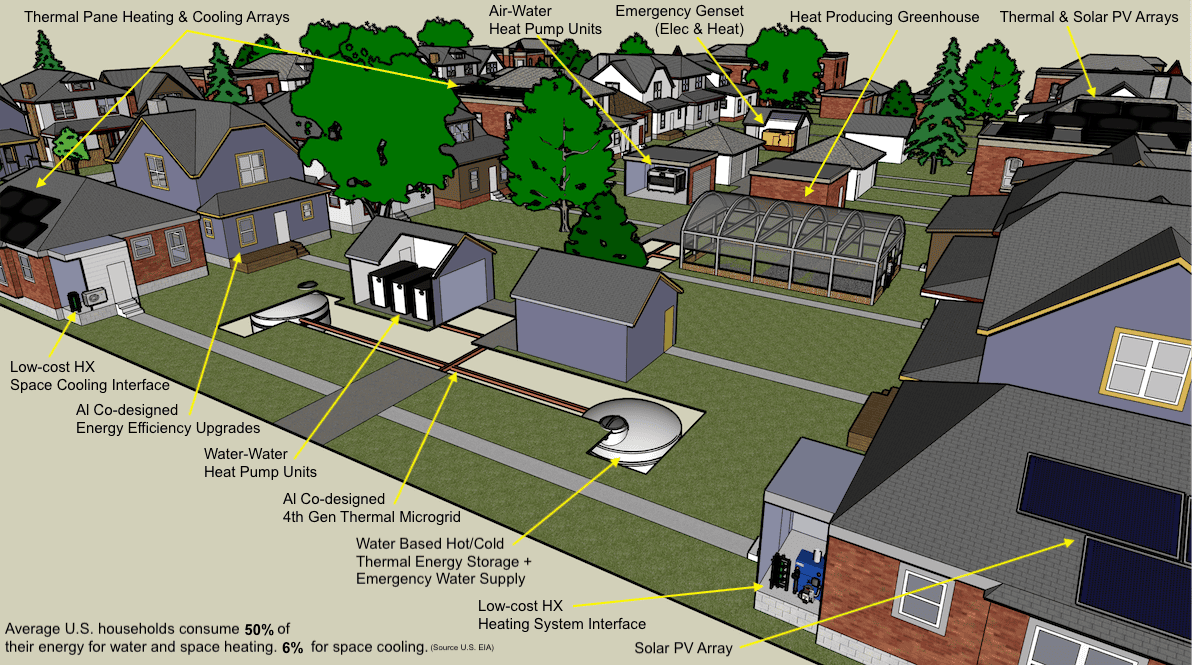
DEPLOYING EXISTING & EMERGING SOLUTIONS AT BLOCK SCALE
Honoring the uniqueness and diversity of each neighborhood, thermal energy networks can become platforms that integrate a variety of emerging and off-the-shelf technologies to give communities the flexibility to adapt, reconfigure, and respond to their own unique needs.
Through a partnership with MMCISolar, OakTREE (Oakland Thermal Renewable Energy and Electrification) has access to a growing portfolio of patents and technologies that will power these platforms. This will enable modular, neighborhood-scale solutions to turn residents from observers into active participants, building both social and economic equity while shaping the energy transition.
OakTREE brings this vision to life by layering multiple community-owned energy assets on top of a thermal microgrid. This isn’t just a technical solution—it’s a new frontier, one that traditional utilities have yet to regulate. It’s a space where communities can take control, create tangible benefits, and start shaping the energy system on their own terms. This is where collective action meets real impact, and the tools to transform tomorrow are already within reach.
Below, you’ll see how some key components work independently and together to build the foundation for community power.
Thermal Microgrid
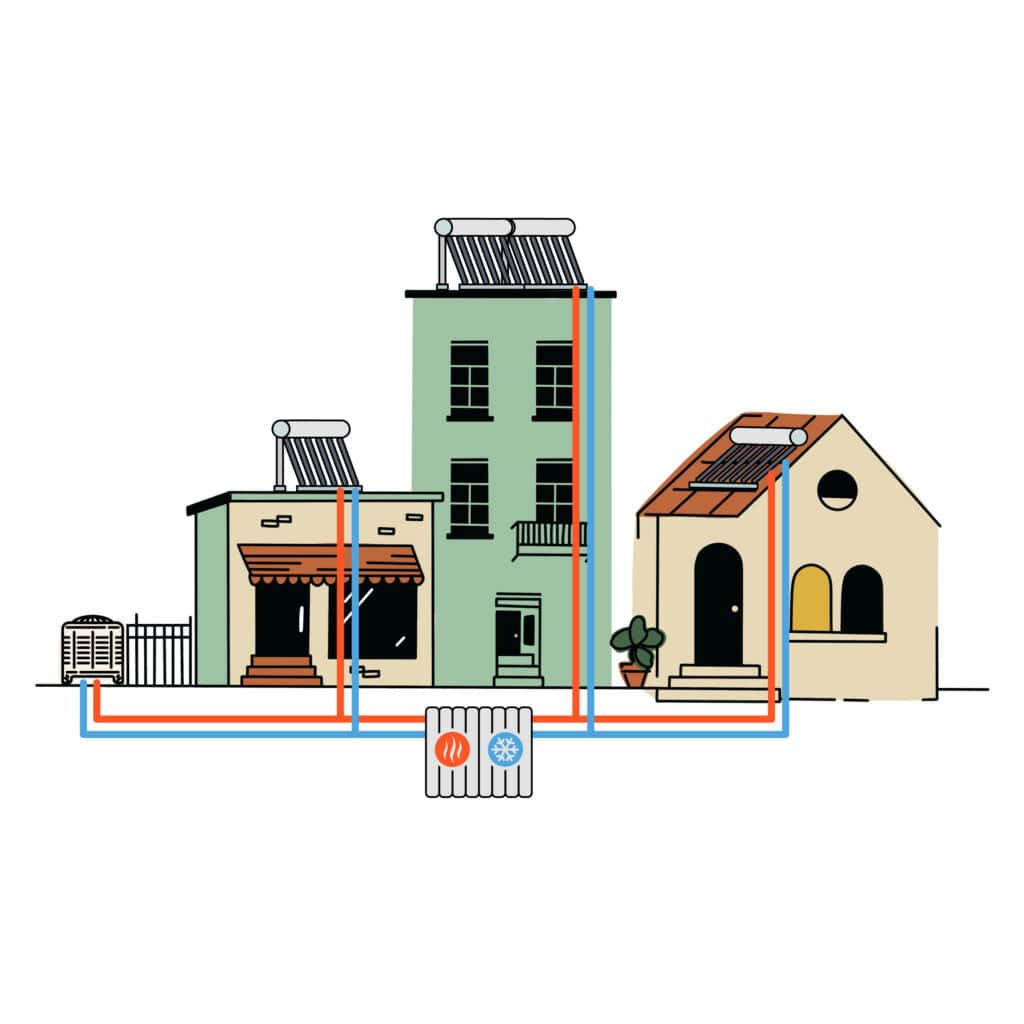
The physical backbone of OakTREE’s inter-structure is the community-owned thermal microgrid: an energy network that connects buildings through a buried pipe loop carrying hot and cold water to supply heating and cooling to buildings. Think of it like district heating, but one city block at a time, owned and governed by the people it serves.
Here’s how it works: Instead of every home installing its own expensive heat pump or air conditioning system, the thermal microgrid aggregates fewer, shared components like high capacity heat pumps, solar thermal panels, and thermal storage across many networked users. This dramatically lowers the cost of installation compared to equipping households on an individual basis. And because much of the deployment can be done with lower-skilled labor (trenching, pipe laying, basic plumbing), it creates local job opportunities while building critical infrastructure.
Why thermal instead of electric?
OakTREE focuses on thermal microgrids for three crucial reasons:
- Size of demand: Heating and cooling represent nearly 65% of energy use for homes and many small businesses, far more than electricity for lights and appliances.
- Rising costs: Both electricity and gas prices are projected to rise substantially in the coming years, making thermal solutions increasingly cost-competitive.
- Regulatory flexibility: There are fewer restrictions around who can supply thermal energy compared to electricity, making it easier to develop community-owned thermal systems within the existing legal framework. This is the space where communities can act now, without waiting for utilities or regulators.
Community-scale thermal networks aren’t new. They’ve been demonstrated across the U.S. and Europe, integrating solar thermal, geothermal, and heat pump technologies with thermal storage. What’s different about OakTREE is the block-level scaling of these systems, the integration of proprietary technologies, and commitment to community ownership and governance, ensuring that the infrastructure serves the people who depend on it rather than extracting value from them.
Studies on community scale thermal microgrids:
Community Heat Pump Systems (both existing and new construction district heating-type projects)
https://www.nyserda.ny.gov/All-Programs/Large-Scale-Thermal/Winners
Heat Pumps Fast Track District Heating Decarbonization
https://www.gea.com/en/stories/heat-pumps-fast-track-district-heating-decarbonization
Smart mini district heating network tackling fuel poverty for elderly communities
Distributed Solar Thermal Power in Small Scale District Heating Systems
Integration of solar thermal systems in existing district heating systems
https://proceedings.ises.org/conference/eurosun2016/papers/eurosun2016-0087-Winterscheid.pdf
Performance Modeling of Hybrid Solar, Heat Pump and Thermal Storage Systems for District Thermal Energy in the United States
Closed Cycle Greenhouse
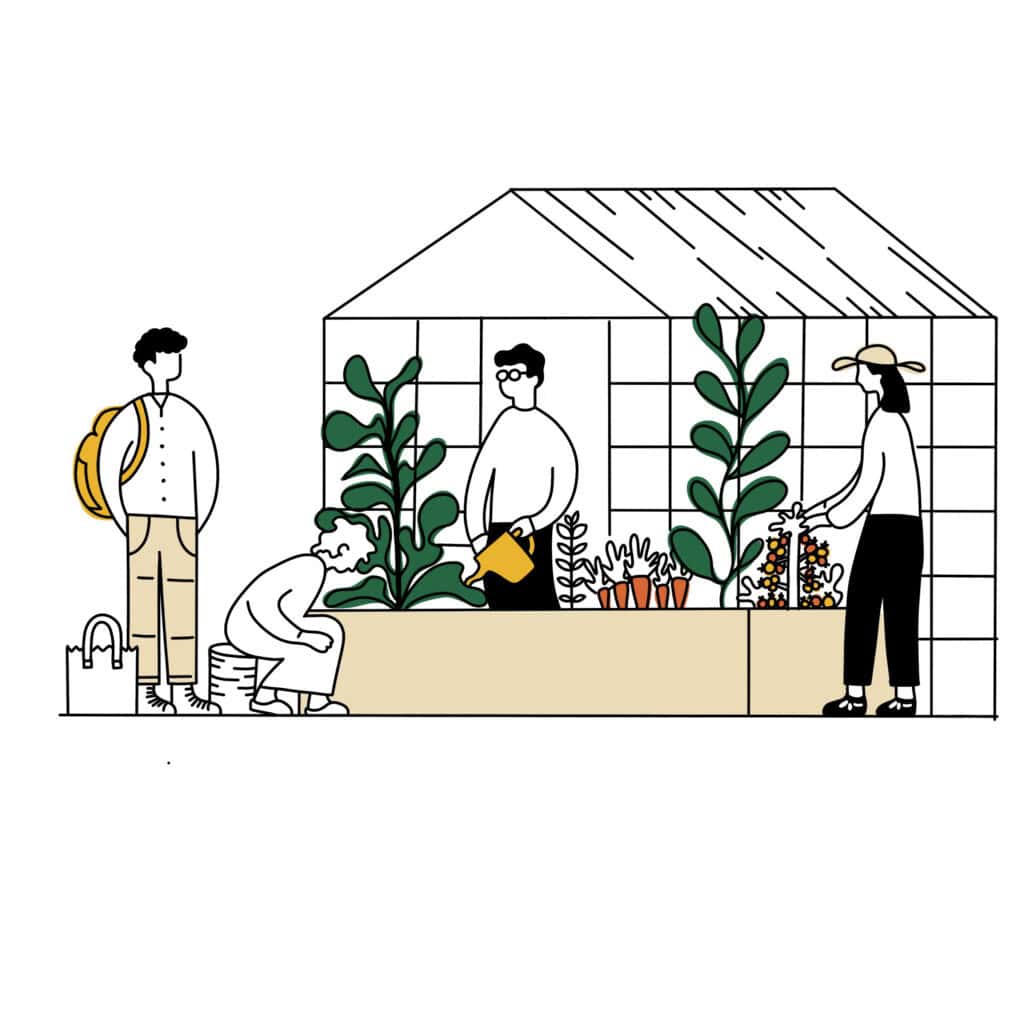
Closed Cycle Greenhouses (CCGs) are high-efficiency growing systems that can achieve yields up to 8 times greater than open field agriculture by tightly controlling environmental conditions—particularly CO2 levels, temperature, and humidity. But they come with a challenge: they generate significant excess heat that typically requires energy-intensive cooling systems to reject this heat to the outside environment.
OakTREE’s approach flips this challenge into an opportunity. By integrating CCGs with thermal microgrids, excess heat from the greenhouse becomes a resource, supplying space and water heating to nearby homes and buildings. This integration reduces the CCG’s energy costs while bringing the benefits of dramatically lower water consumption, pesticide use, and emissions compared to conventional agriculture. It also makes CCGs far more attractive for urban and peri-urban settings, where land is scarce and the people who need fresh food are close by.
For neighborhoods that have long been food deserts, embedding high-yield food production directly into the community—connected to the same thermal network that heats homes—fundamentally changes what’s possible. It’s not just about growing food; it’s about growing it affordably, locally, and in a way that strengthens both food security and energy resilience.
One of the key questions we’re working to answer through our demonstration projects is whether food produced in a CCG integrated with a thermal microgrid can actually cost less than what’s available at local stores. Early models suggest it’s possible, but we need real-world data to prove it. If we’re right, this becomes a pathway to affordable fresh food, produced and distributed by the community, for the community.
Studies on Closed Cycle Greenhouses
Energetic evaluation of a solar collector greenhouse with above-ground heat storage
The Watergy Greenhouse: A Closed System for Solar Thermal Energy Collection, Water Treatment and Advanced Horticulture
OakTREE Embedded Closed Cycle Greenhouses
Community E-Kitchen & EV distribution services

In a time when food costs are rising and federal support like SNAP faces cuts, access to affordable, nutritious food is becoming a human rights issue—and a climate justice issue. A community e-kitchen creates a direct response: a shared space where neighbors can prepare meals together, process produce, and cook for those in need, transforming the fresh food from Closed Cycle Greenhouses into nourishment that stays in the neighborhood.
Paired with community EV distribution services, these renewably powered, emission-free kitchen facilities can support farm-share subscriptions or meal distribution programs, bringing fresh produce and prepared meals directly to residents, especially those with limited mobility, fixed incomes, or living in food deserts. This is infrastructure designed to ensure that everyone in the community can eat well, regardless of what’s happening at the government level.
As CCG production scales and costs decrease, these services will become increasingly viable, creating opportunities for community entrepreneurs to build sustainable, food-centered businesses while addressing a fundamental need. Together, the e-kitchen and EV services close the loop between what’s grown in the neighborhood and who gets to eat it, building the kind of food sovereignty that lets communities feed themselves on their own terms.
Studies on Community E-Kitchens & CSAs
Social health and nutrition impacts of community kitchens: a systematic review
https://pmc.ncbi.nlm.nih.gov/articles/PMC10271777
Power Shift: All-Electric Kitchens
https://fesmag.com/topics/trends/21677-power-shift-all-electric-kitchens
Population Health Impact and Cost-Effectiveness of Community-Supported Agriculture Among Low-Income US Adults
Local Manufacturing

OakTREE’s vision includes nurturing locally-owned manufacturing that supports the regenerative economy we’re building, creating jobs, building skills, and keeping economic value circulating within communities.
Some sectors are already primed for this work. Food manufacturing, for instance, has vibrant, cost-competitive operations that can be directly supplied by local greenhouse growers. OakTREE will work to encourage more of these businesses to open, creating a direct pipeline from CCG production to value-added food products like packaged meals, preserved goods, or specialty items—all made and sold locally.
Beyond food, there’s opportunity in manufacturing components for thermal microgrids themselves. Heat pumps, thermal storage tanks, rooftop panels, and other system components are beginning to move back onshore in the U.S., and with sufficient investment, they can become a significant source of local manufacturing jobs. OakTREE envisions supporting light manufacturing businesses that conduct semi-automated final assembly of these components, training residents in skilled trades while building the supply chain that makes inter-structure possible.
Is local manufacturing always the most cost-effective option? Not necessarily. But it brings benefits that pure cost analysis misses: resilience to economic shocks caused by tariffs or global supply chain disruptions, more local jobs with shorter commutes and wage retention, and the ability to adapt production quickly to community needs. OakTREE works to create an environment where these broader benefits (economic stability, community wealth-building, and self-determination) are valued alongside cost efficiency.
When communities can manufacture what they need, they’re not just consumers waiting for solutions to arrive from elsewhere. They’re producers, builders, and stewards of their own economic future.